Hospitality guide
Restaurant Patio Heating: The Buyer's Guide to Year-Round Outdoor Revenue
A practical buyer's guide for restaurant, café, and hotel operators choosing patio heaters — covering coverage, fuel type, runtime, regulation, and the 5-year total cost.
Why patio heating pays back
The median European restaurant patio turns a 40% higher check than the equivalent indoor table when occupied. It also turns zero revenue for 5–6 months a year in most climates. The math on a quality patio heater system is brutal in a good way: a 4-figure equipment investment that unlocks 4-figure monthly revenue for 5–6 months a year, for 5–10 years.
The question is not whether to heat the patio. The question is how to heat it well, safely, and at the lowest 5-year cost.
Choose the right fuel: electric, gas, or hybrid
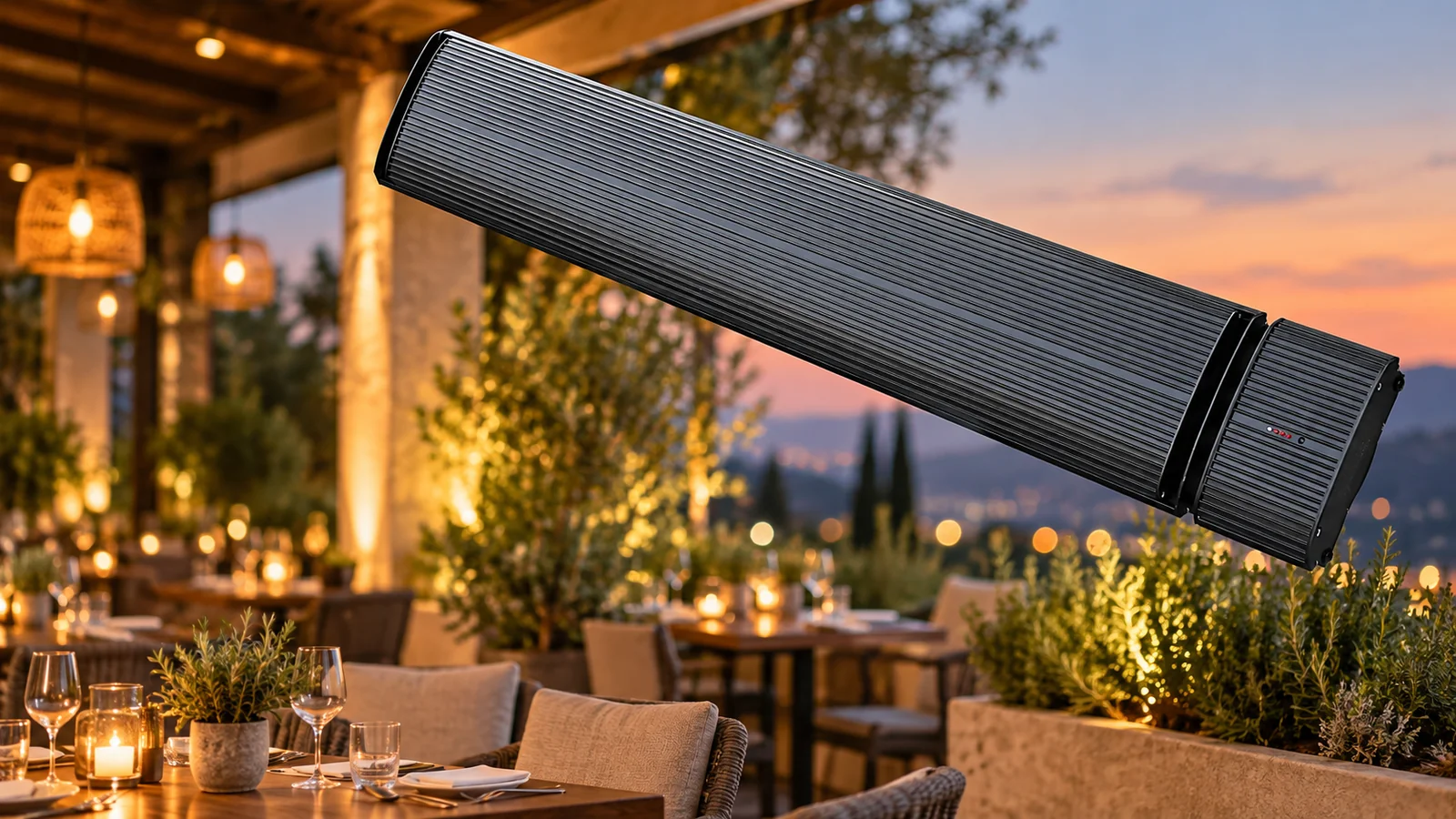
Electric infrared
- Best for: Covered or semi-enclosed patios, pergolas, retractable awnings, anywhere you have a power outlet and a fixed installation.
- Pros: Zero on-site combustion, no CO₂ or water vapor, no fuel storage, no gas-line permit, push-button start.
- Cons: Runtime cost is tied to local electricity tariffs. In Germany at €0.32/kWh, a 2,000W heater running 4 hours costs €2.56 per evening. In Texas at €0.10/kWh, the same evening costs €0.80.
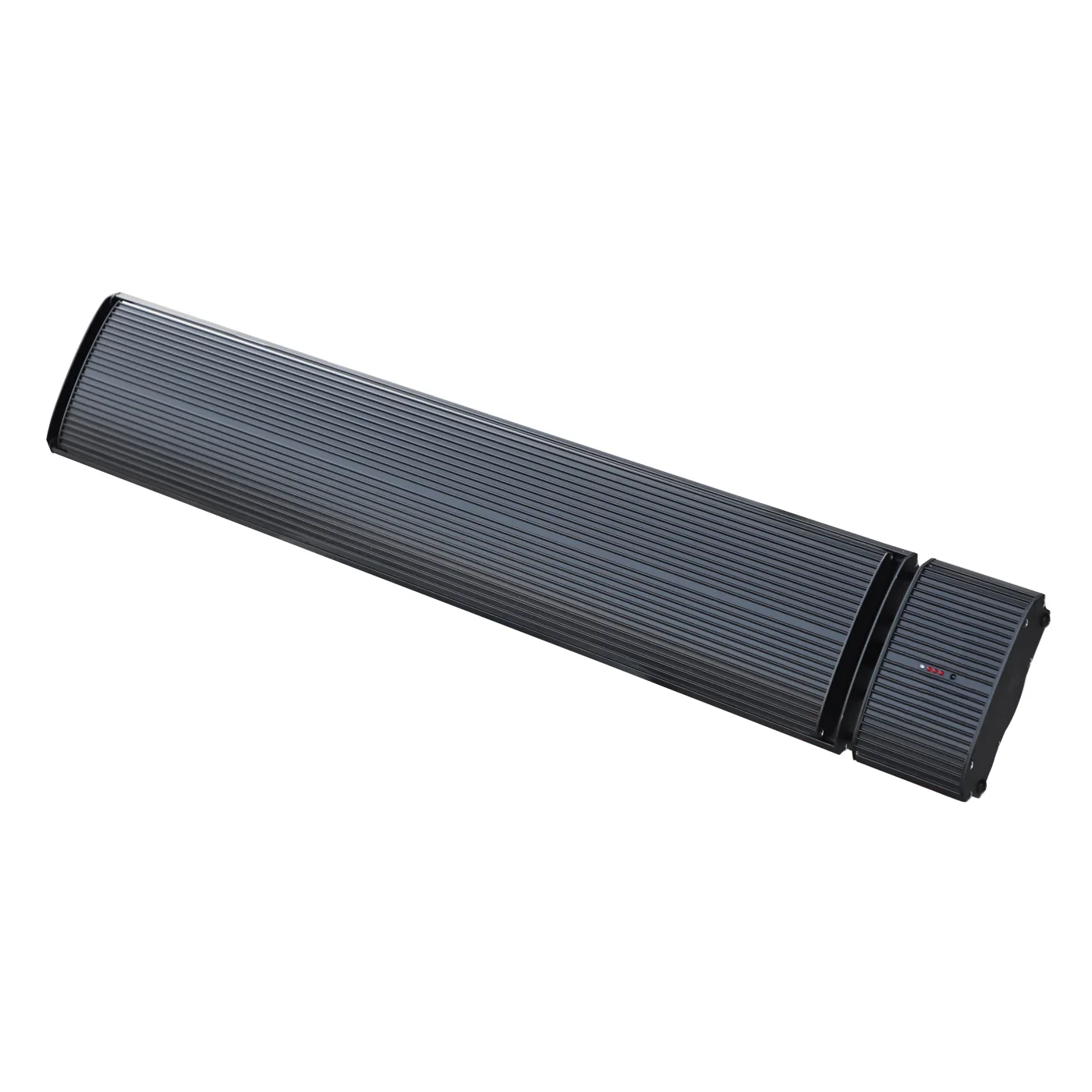
- JHCOOL range: Wall-mounted, ceiling-mounted, and freestanding 1,500–3,000W far-infrared units, IP65 rated.
LPG (propane) gas
- Best for: Open-air patios where running electrical cable is impractical or impossible, pop-up events, food trucks.
- Pros: No cable runs, no electrician, instant on/off, high radiant output per kilogram of fuel.
- Cons: Tank changes (typically every 8–12 hours per heater), local regulations on tank storage indoors, combustion gases require ventilation, an LPG heater on a fully enclosed patio is a CO hazard.
- Cost per evening: Roughly €3–5 per heater per 4-hour evening at current European LPG prices.
Natural gas (mains)
- Best for: Fixed installations where a gas line is already in place, large patio footprints, year-round operation.
- Pros: Lowest running cost of any fuel. No tank swaps. Continuous operation.
- Cons: Professional installation only, gas-safety inspection required in most jurisdictions, a permanent visible flue or roof penetration on certain models.
The honest recommendation
For most restaurant and café operators in 2026, the best answer is a hybrid: fixed electric infrared for the covered 70% of the patio where guests sit most of the time, plus 1–2 freestanding LPG units for flexibility on the open 30% during peak events.
Sizing: how many heaters, what wattage
A common rule of thumb for far-infrared patio heating in a covered, semi-enclosed space:
- Mild winter (Mediterranean, California): 100–120W per m²
- Cool winter (Central Europe, US Northeast): 150–180W per m²
- Cold winter (Northern Europe, Mountain West): 200–250W per m²
For a 40 m² covered patio in central Italy, you are looking at 6–8 kW of total installed capacity — typically four 2,000W wall-mounted units, or two 3,000W ceiling units plus two 1,500W wall units for spot coverage on the bar.
Placement rules
- Height: Mount infrared heaters 2.0–2.4 m above floor for seated guests, 2.5–3.0 m for standing/mixed use. Below 1.8 m, guests feel the heat on the back of the neck; above 3.5 m, most of the energy misses them entirely.
- Angle: Tilt 30–45° downward. Direct downward (90°) puts hot spots on the floor; horizontal (0°) throws half the energy above the guests’ heads.
- Overlap: Stagger heater positions so the radiant cones overlap by 20–30%. Edge-of-coverage is colder than center; an overlap zone averages out.
- Wind direction: On an open patio, put the heaters on the upwind side. Cold wind cuts the perceived radiant heat dramatically; blocking the wind first lets the radiant heat do its job on a still column of air.
The 5-year cost — a worked example
A 40 m² covered patio in Lyon, France, heated October through April (7 months):
| Item | Electric infrared (8 kW) | LPG mushroom (4 × 12 kW) |
|---|---|---|
| Equipment (4 × JHCOOL 2,000W) | €1,800 | €1,200 (4 × €300 mushroom heaters) |
| Installation (electrician + mounting) | €600 | €0 (freestanding) |
| Fuel, 7 months × 4h/evening × 60 evenings | €768 (4 kWh × 60 × €0.32) | €2,160 (€9/evening in LPG) |
| Maintenance (5 years) | €200 (element replacement year 4) | €400 (annual regulator + 1 replacement heater year 3) |
| 5-year total | €3,368 | €3,760 |
| Per evening | €11.23 | €12.53 |
Electric wins on total cost, install cleanliness, and guest experience (no combustion smell, no tank changes mid-service). LPG wins on flexibility and zero installation.
What to ask before you buy
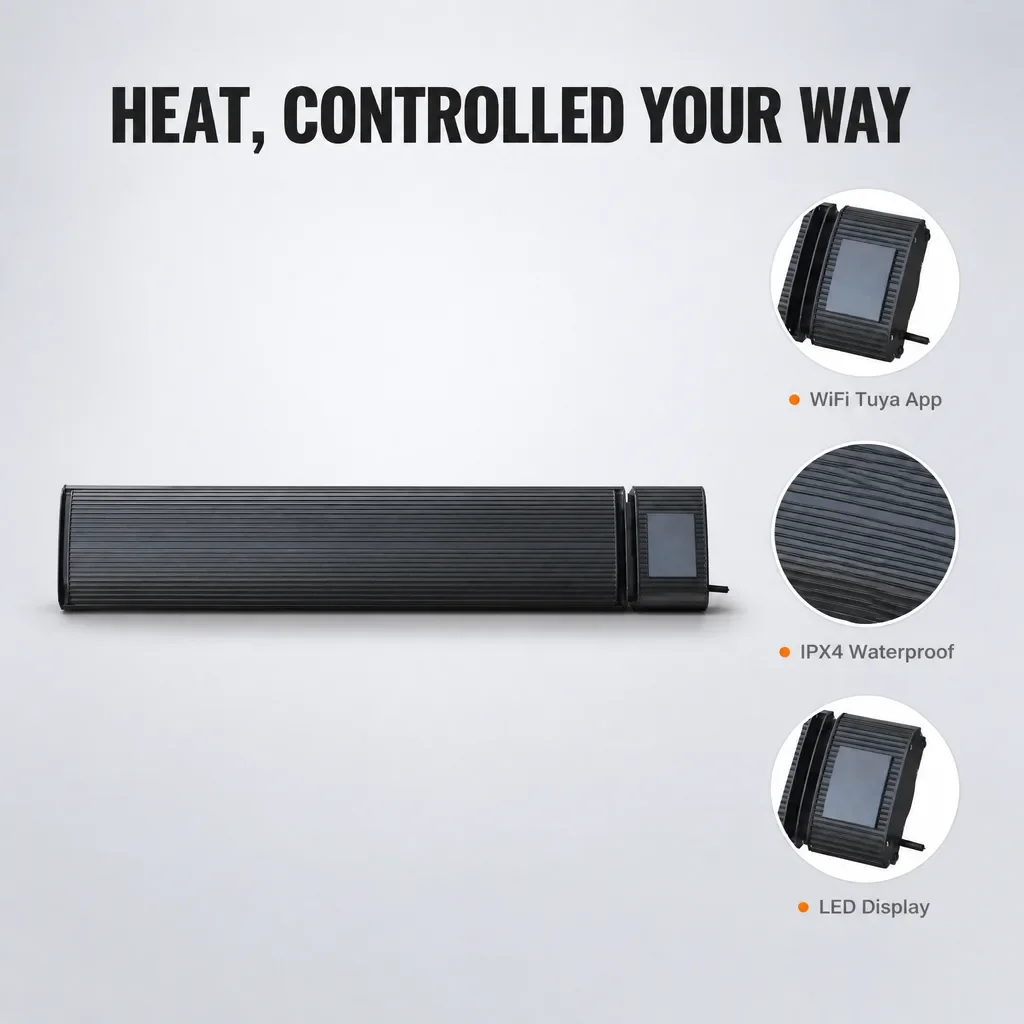
- What is the IP rating of the unit? (IP65 for any outdoor or semi-outdoor use, no exceptions.)
- Is the emitter far-infrared (3–100 μm) or near-infrared halogen (visible orange glow)? Far-infrared is gentler and more efficient for human comfort; near-infrared is brighter and better for very high-ceiling industrial spaces.
- What is the reflector material? Anodized aluminum is the industry standard; polished stainless is premium; painted steel is a cost-cut you do not want.
- What safety certifications does the unit carry? CE is mandatory in Europe, CB is the international baseline, SAA is required for Australia, RoHS confirms the materials are within restricted-substance limits. Ask for the actual certificates, not just the logos.
- What is the warranty on the emitter element? 2 years minimum; 3 years is competitive. Anything less suggests the manufacturer does not trust their own component.
The bottom line
Patio heating is a revenue decision disguised as a capex decision. A 5-year view will usually favor electric infrared for fixed installations and LPG for flexible or pop-up use. Either way, the difference between a quality unit and a cheap one is the difference between a patio guests linger on and a patio they leave after one drink.
Send us your patio dimensions, your location, and a photo of the space. We will send back a layout plan with heater positions, electrical specs, and a 5-year cost comparison — free, no commitment.