Cooling technology
How Evaporative Coolers Work: The 4-Step Cycle Behind 80% Lower Cooling Bills
A desert-tested, 4-step explanation of how evaporative air coolers turn 380W of electricity into a 10°C air-temperature drop — and why they cannot fail in dry climates.
The 4-step cycle
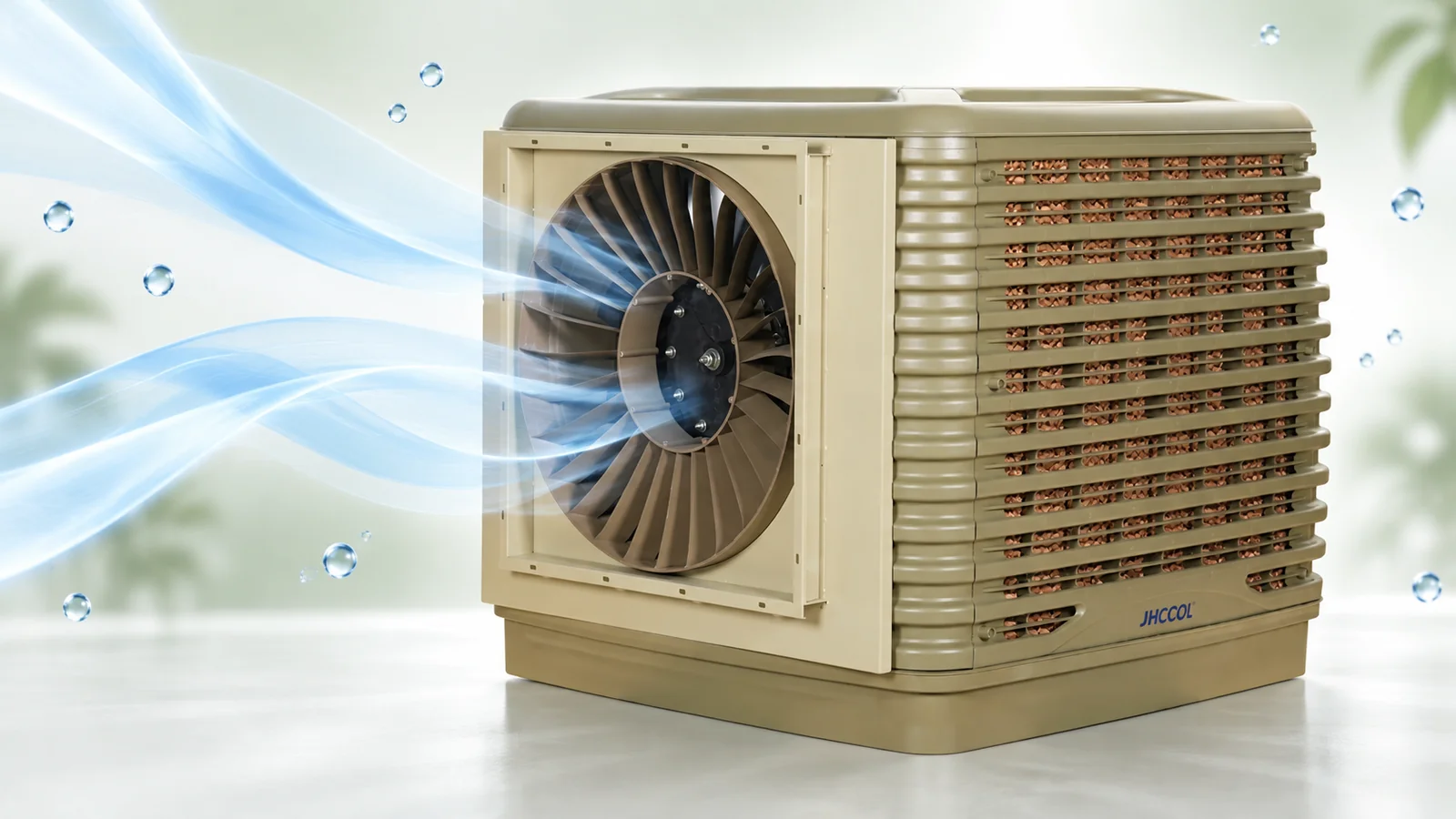
Every evaporative cooler — from a 110W household unit to a 380W industrial machine — does the same four things, in order, every second it runs:
- Pull dry outside air through a wet cooling pad. A pump trickles water over a cellulose or polymer pad. The pad stays saturated. A fan pulls hot outside air through it.
- Water evaporates into the air stream. As the water turns to vapor, it absorbs its latent heat of vaporization — 2,260 kJ per kilogram of water evaporated. That energy leaves the air. The air comes out cooler and slightly more humid.
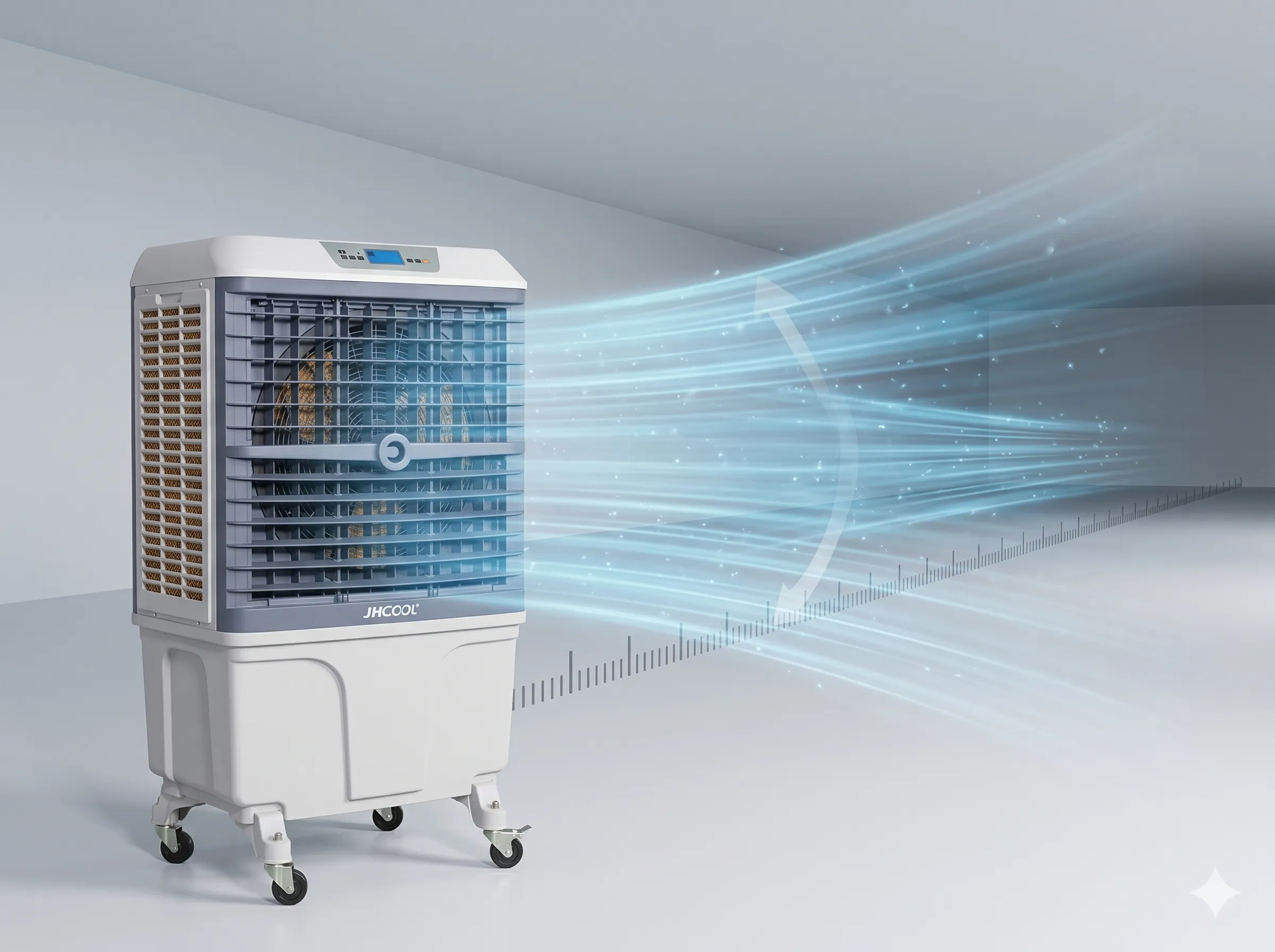
- The cooled air moves into the room. A 30,000 m³/h industrial unit will completely change the air in a 200 m² warehouse once every 90 seconds. There is no recirculation, no refrigerant loop, no compressor.
- A small drain carries away concentrated mineral water. The water that does not evaporate stays in the sump. As it sits, minerals concentrate. A float valve adds fresh water; an overflow drains the concentrate. On a 380W industrial unit, expect 9–11 L/h of water consumption in hot, dry operation.
That is the entire machine. No compressor, no condenser coil, no expansion valve, no refrigerant. The "refrigerant" is water.
What the air actually feels like
The outlet temperature of an evaporative cooler is the wet-bulb temperature of the inlet air — the temperature the air would have if you cooled it to 100% saturation. In a hot, dry climate:
| Inlet conditions | Wet-bulb | Approx. outlet |
|---|---|---|
| 40°C, 15% RH (Phoenix afternoon) | ~19°C | ~21°C at the unit |
| 35°C, 30% RH (Madrid summer) | ~22°C | ~24°C at the unit |
| 30°C, 50% RH (Italian plains) | ~22°C | ~24°C at the unit |
| 28°C, 80% RH (Singapore) | ~26°C | ~27°C at the unit |
The first three rows are why evaporative cooling dominates arid and semi-arid markets. The fourth row is why it does not work in equatorial Southeast Asia. The air is already close to saturation; the physics has nothing left to give.
The electrical math
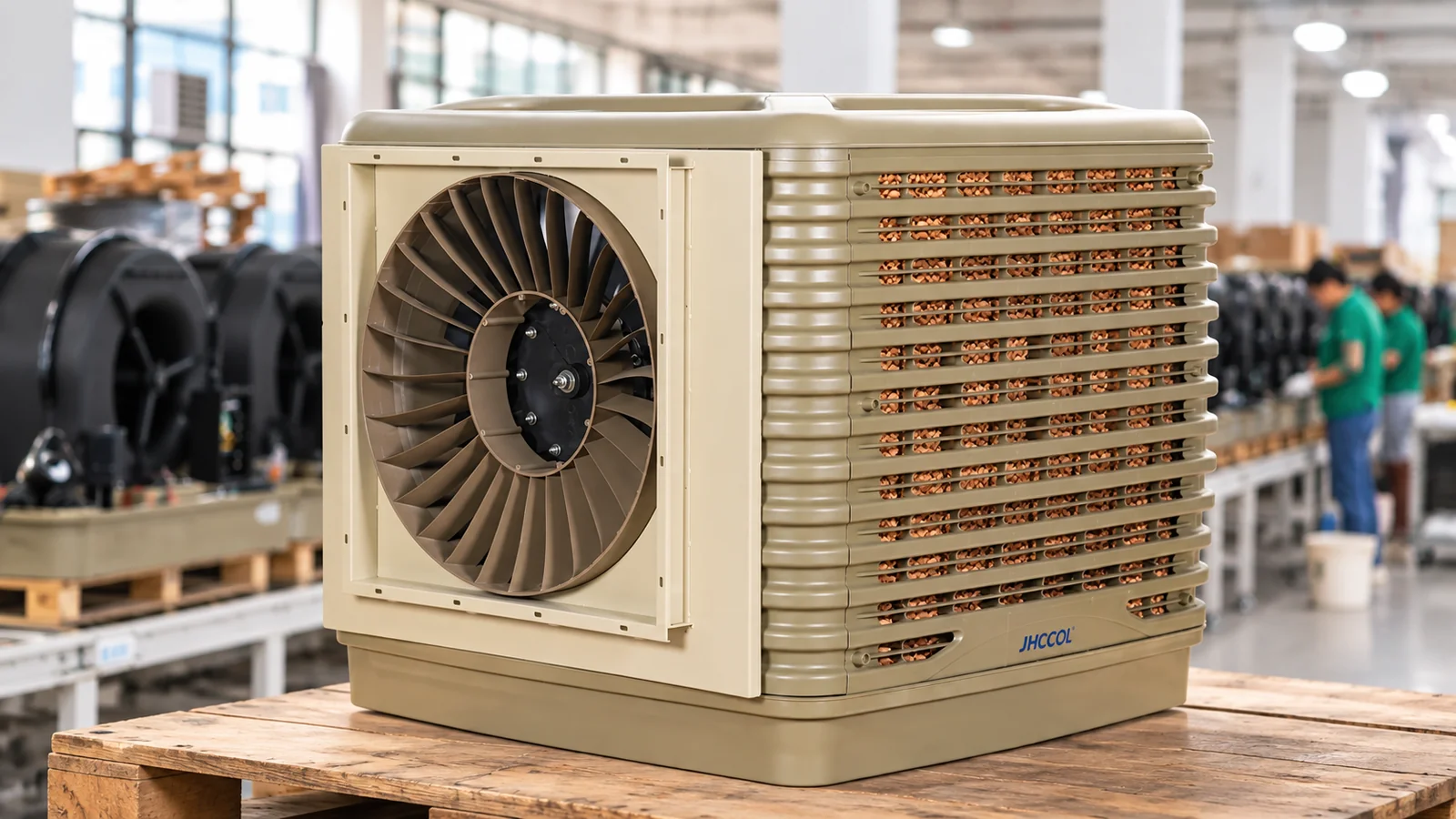
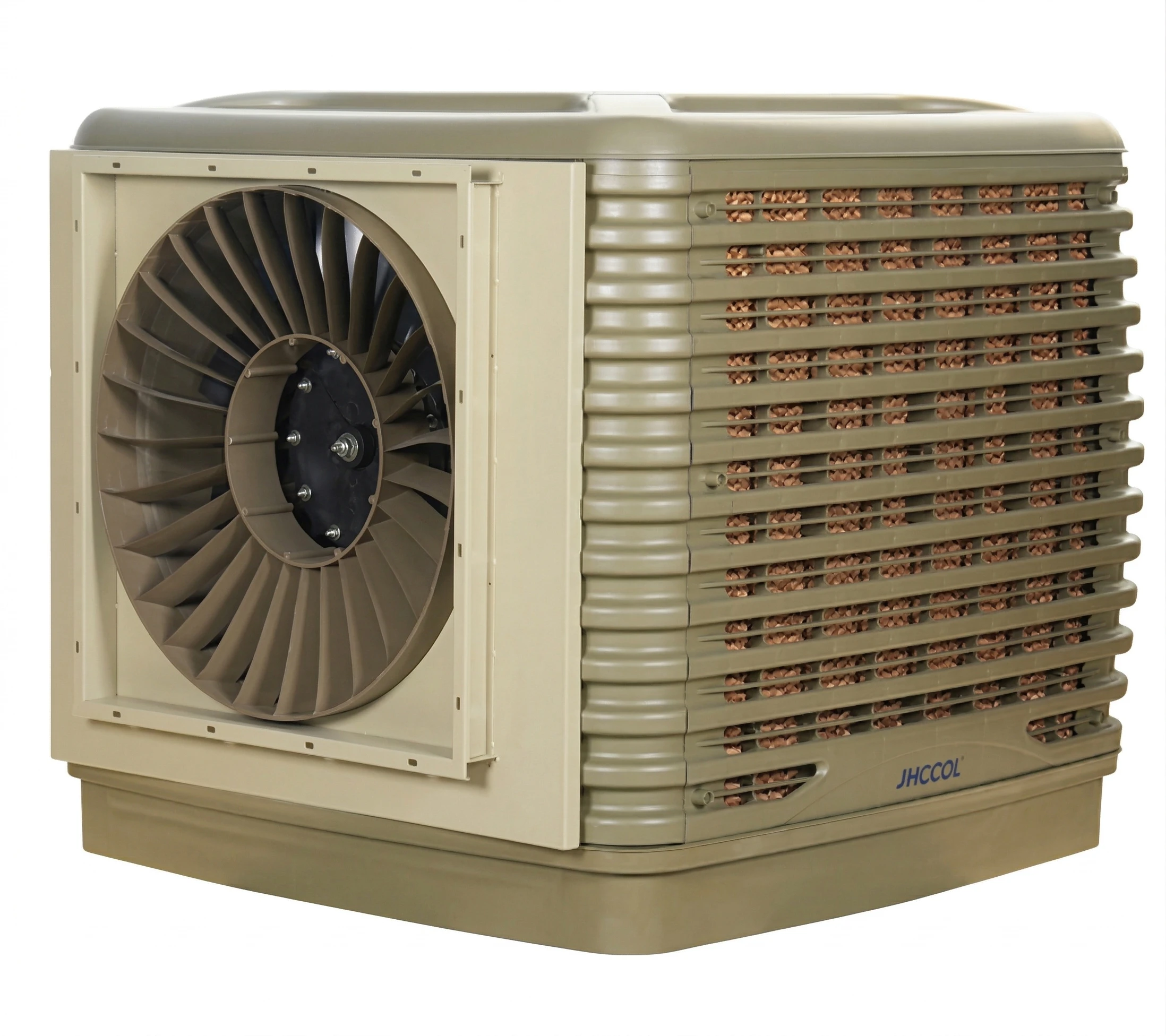
The JHCOOL 30 Series industrial cooler moves 30,000 m³/h on 380W. The closest refrigerant split A/C that delivers a comparable airflow and a comparable temperature drop in a warehouse draws about 1,500W. That is a 4× difference at the meter, sustained across every hour the unit runs.
In a typical 8-hour operating day over a 6-month cooling season, the 380W evaporative unit costs roughly €98 in electricity. The split A/C costs about €389 — same delivered air, same working environment, four times the bill.
Why builders and procurement teams pick evaporative over refrigerant in the right climate
- First cost. A 30,000 m³/h industrial evaporative cooler is roughly 1/3 the price of an equivalent packaged DX unit. There is no outdoor condenser to install, no refrigerant lines to braze, no commissioning engineer on site.
- Ventilation air for free. Every cubic meter the cooler moves is outside air. You get fresh-air ventilation as a side effect. In a factory, warehouse, or workshop, that often eliminates the need for a separate mechanical ventilation system.
- Maintenance is owner-doable. Pad replacement once per season, pump impeller inspection quarterly, basic fan motor service annually. No licensed HVAC technician required.
- No refrigerant regulatory burden. R-410A phase-down, F-Gas compliance documentation, leak inspections — none of it applies.
When evaporative is the wrong tool
If your site is below 20°C wet-bulb for most of the cooling season (most of Northern Europe, the Pacific Northwest, much of the UK), a refrigerant system is the only honest answer. If you need sub-18°C controlled-temperature environments (server rooms, pharmaceutical storage, precision manufacturing), evaporative cooling cannot get you there. Use the right tool for the climate and the application.
Tell us your city, your space dimensions, and your target temperature. We will spec the right unit — or tell you honestly that an evaporative cooler is not the right call.